 Doha New
Doing wall squats or planks just once a week can help lower and maintain blood pressure, according to the results of a new clinical trial. Researchers explored whether specific forms of exercise could help maintain the blood pressure when working out less frequently. They particularly researched the effects of isometric exercises, a form of strength training where your muscles contract without joint movement or changing length.
This is contrary to standard lifts like a bicep curl or squat, in which muscles shorten and lengthen as you move a weight through a full range of motion. In the study, 100 participants with an average age of 37 followed interval endurance training (IET). In IET, people alternate between high-intensity phases pushing one’s heart rate up to 85 per cent of its maximum capacity for up to five minutes, followed by shorter recovery or rest periods.
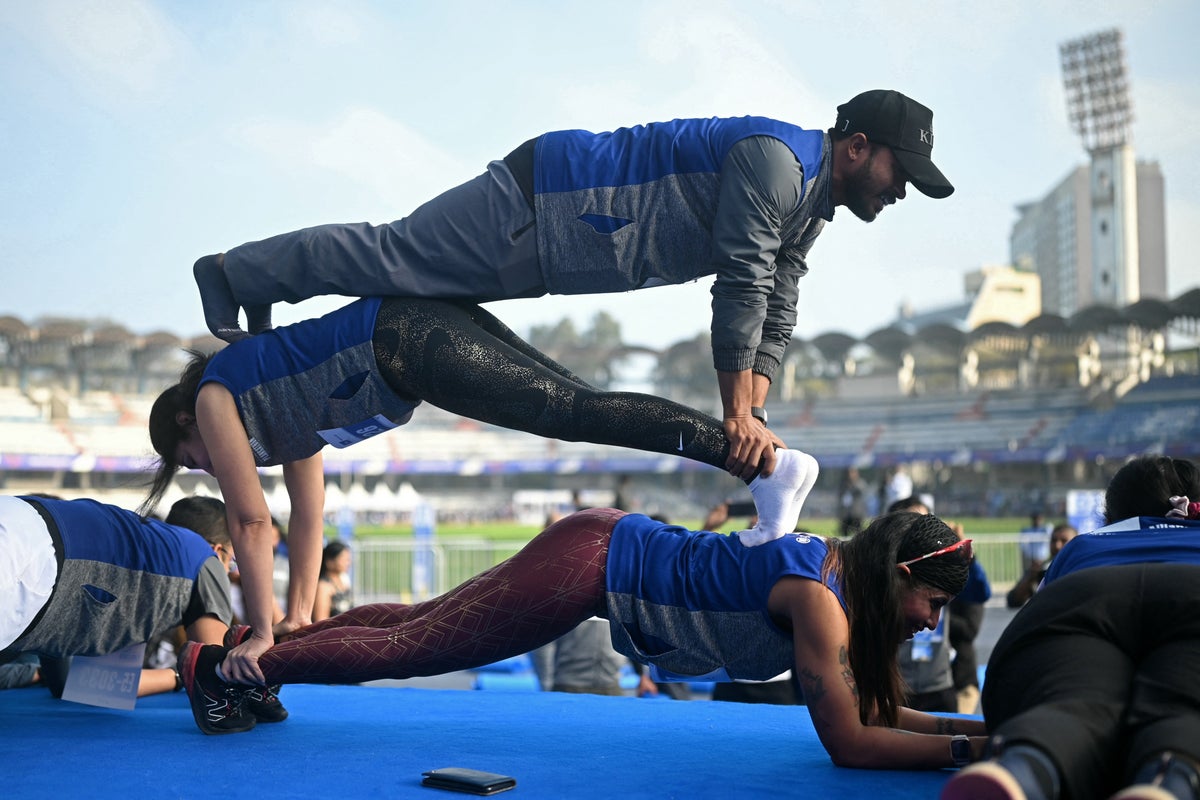
Participants perform abdominal plank over each other (AFP via Getty Images) Participants gradually reduced how often they trained to see whether exercising less frequently could help preserve these benefits. Researchers examined the biological changes that happened along with blood pressure improvements among the participants during the eight-week study period. After four weeks, participants who followed IET had blood pressure about 9.5 mmHg lower than in the control group.
In the subsequent four weeks, participants exercising once or twice weekly maintained some of their reductions, the study found. French model Hinarere Taputu takes part in a fitness session (AFP via Getty Images) While people who continued to exercise three times a week saw the most benefit, those who continued with one or two isometric exercises – like wall sits or planks – still maintained a reduction in their blood pressure. "Our findings show that exercising three times a week was associated with better reductions in blood pressure and maintenance of a wider range of physiological benefits,” said Jim Wiles, an author of the study published in BMJ Open Sport & Exercise Medicine.
“But even exercising just once a week can help maintain some health benefits over a short four-week period, making it a practical option for people,” said Dr Wiles, professor of exercise science at Canterbury Christ Church University, The findings overall prove that the frequency of isometric exercise training matters, with different amounts of training influencing both blood pressure and the heart health. They provide “the first robust evidence of a frequency-dependent dose-response to IET”, scientists wrote. “Exercise does not have to be all or nothing.
Our findings show that when life gets busy, as it often does, reducing to just one isometric exercise session per week may help sustain the blood pressure benefits already achieved until a more regular routine can be resumed,” said Harry Swift, another author of the study. “This flexibility could make isometric exercise training a more sustainable way for people to manage their blood pressure and support their long-term cardiovascular health,” Dr Swift said.
Source: The Independent